Blue reflectors on road marker posts
What are they for and how should I behave?

Sven Meier
Driving teacher and President
of Verkehrsschule Zug
A SchlauMeier—who doesn’t know one? But a SchlauMeier is by no means just a know-it-all. Rather, it is a person who impresses with well-thought-out contributions and clear, understandable explanations, thereby enriching their surroundings. This is exactly the intention of Sven Meier, driving instructor and president of the Verkehrsschule Zug, in this diverse column
Autumn is just round the corner. The days are getting shorter, temperatures are dropping and nature is slowly preparing for winter. For us motorists, however, this also means that we must once again be on the lookout for wildlife crossing the roads. Wild animals, such as roe deer, are most active at dusk and during the night. You may have noticed that certain guide posts have blue reflectors attached to them. What do these mean? It’s time to shed some light on the matter.
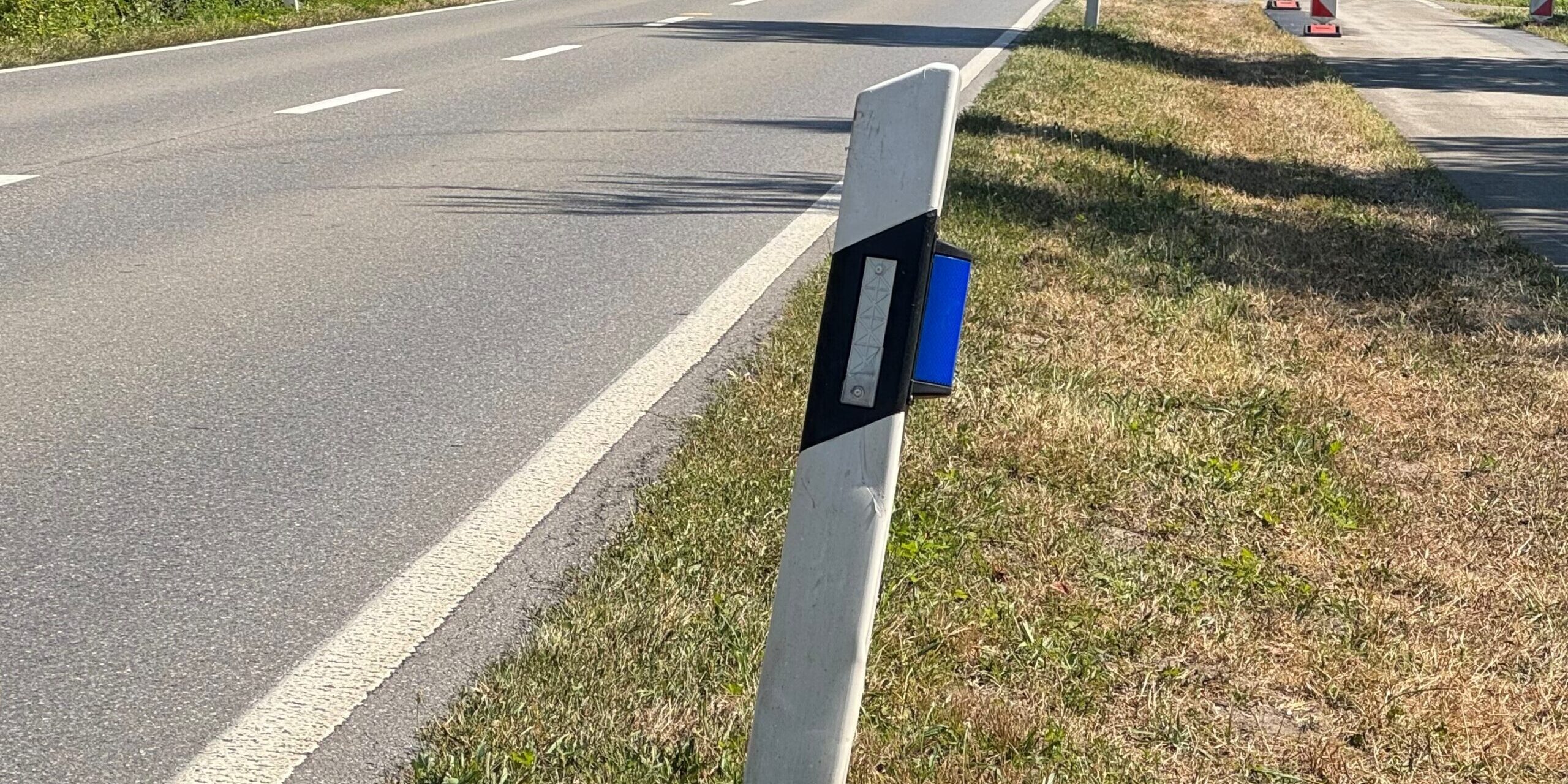
Everyone is probably familiar with the classic guide posts. Around one metre high, white with black markings and the familiar reflectors. They help us to better recognise the course of the road in the dark or in poor visibility. On an increasing number of stretches of road, however, particularly in rural areas, an additional detail catches the eye: blue reflectors.
The blue light fence
No, the blue reflectors have nothing to do with a new traffic regulation, nor do they indicate a speed limit. Their sole purpose is to protect people and animals.
For years, experts have been searching for a cost-effective solution to reduce collisions with wildlife, particularly on roads where animals frequently cross. Whilst wildlife fences would be effective, they are expensive and would severely restrict the animals’ natural migration routes.
The solution is surprisingly simple: when a car’s headlights hit the blue reflectors, the light is scattered sideways towards the edge of the forest. This creates what is known as a ‘blue light fence’. Many wild animals perceive this blue light as a danger and, at that moment, prefer to stay in the safety of the woodland rather than cross the road. As soon as the vehicle has passed, the light fence disappears again automatically. A simple idea with a major goal: fewer collisions with wildlife and greater safety on our roads.It is also important to remember: if you see a wild animal at the side of the road, reduce your speed immediately and be prepared for other animals to follow. A roe deer rarely travels alone. Furthermore, do not try to swerve to avoid an animal with a sudden steering manoeuvre. In most cases, controlled braking is significantly safer than an evasive manoeuvre that ends up in oncoming traffic or off the road.
It’s worth taking a look at the light switch
Finally, here’s a tip that’s particularly important in autumn and winter. Many modern vehicles drive during the day on the ‘Auto’ setting or with just the daytime running lights on. This works fine when visibility is good. However, as soon as fog, heavy rain or snowfall reduces visibility, you should not rely on the automatic setting. In many vehicles, the daytime running lights only illuminate the front; the rear lights remain off. This makes the vehicle significantly less visible from behind.
You should therefore make a point of switching to dipped headlights in fog or poor visibility. This ensures you are more easily spotted by other road users. At the same time, the blue wildlife warning reflectors also work optimally, as they require the light from the headlights to create the protective ‘blue light barrier’.
Conclusion:
The blue reflectors are a good example of how even small measures can sometimes have a big impact. They are inexpensive, do not disrupt traffic and help keep wildlife off the road.
If, in addition, we switch on the correct lights, adjust our speed to the conditions and take particular care when driving at dusk, we ourselves can make the greatest contribution to improving safety.